How to prepare your roof for Douglasville storm season
Get your roof ready for Douglasville storm season with a checklist built on the local record: hail, thunderstorm wind, falling trees, and heavy rain, not northern ice problems. Here is what to check, what to fix first, and what to document before the next warning.
Douglasville storm season has two peaks: March to May, the primary severe season for hail and thunderstorm wind, and September to November, a secondary season that includes tropical remnants. The local record shows what those seasons do: the 7 March 2008 EF1 tornado, the 3 May 2021 EF1 tornado that tracked from Bill Arp toward Chapel Hill, quarter-size hail with 60 mph gusts on 7 August 2023, and the 21 September 2009 flood. Preparation means fixing the weak points those events exploit, and documenting the roof before the storm so any claim after it can be proven.
How to prepare your roof: Why Douglasville Storm Season Is Hard on Roofs
Douglas County roofs face four different stresses at once. Hail bruises shingles and dents vents. Thunderstorm wind, published in county rollups at 50 to 64 knots across 159 events over 30 years, lifts tabs and drives rain under laps. Trees drop limbs and load valleys and gutters with debris. And humid subtropical summers keep attics hot and shingles ageing faster than in cooler climates. One thing Douglasville roofs do not face as a code issue is ice dams: an ice barrier is required by the IRC only where the average January temperature is 25 degrees Fahrenheit or below or where ice-dam history exists, and Douglasville's January mean is about 42 degrees, 17 degrees clear of the trigger. Any self-adhered eave or valley membrane here is an optional system upgrade, never a code requirement, and any contractor selling it as code-required is mistaken. The 2024 IRC with Georgia Amendments, effective 1 January 2026, is the code in force for this discussion.
Your Pre-Storm Roof Inspection Checklist
- Shingle field: missing, lifted, curled, or bruised shingles, and granule loss in gutters.
- Flashing and penetrations: valleys, chimneys, skylights, vents, and pipe boots, with sealant intact.
- Ventilation: intake and exhaust balanced, with no powered vent mixed with a ridge vent on the same attic.
- Gutters and downspouts: clear, pitched, and discharging away from the foundation, with pine-needle guards considered where canopy is heavy.
- Trees: dead limbs over the roof identified for removal before they become projectiles.
- Attic: no daylight through the deck, no damp insulation, no soft deck sections.
- Documentation: dated photos of every slope, taken before the season, so post-storm changes can be proven.
A roof inspection before March covers all of this in one visit, and our storm damage roof repair page explains what happens after a storm hits. Homeowners along the 2021 tornado track can also see our Bill Arp roofing page for local context.
Roof Maintenance Tasks to Do Before Storm Season
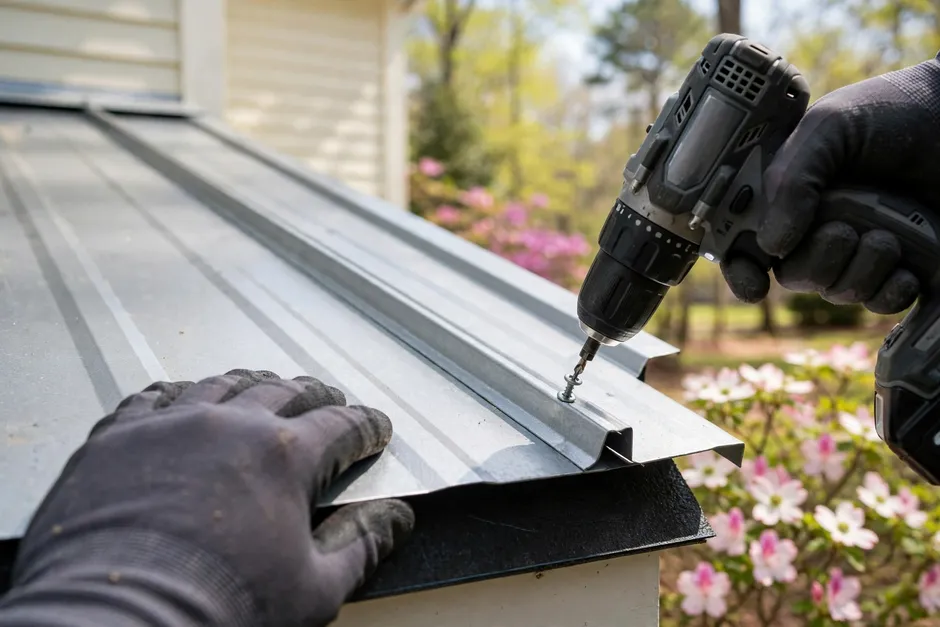
Do the small jobs in February, before the March peak: replace cracked pipe boots, re-seal small flashing joints, clear valleys and gutters, re-secure loose flashing, and trim dead limbs over the roof. On a roof in the 2000s cohort, now 17 to 26 years old, this is also the time to get a straight answer about remaining life: architectural shingles have a realistic 25 to 30 year life, so a 2000s roof is entering its replacement window, and a maintenance visit that finds widespread curling or granule loss is really a replacement conversation. Build year is not roof age, so confirm when the roof itself was last replaced.
How to Prevent Storm Damage to Your Roof
No roof is storm-proof, and this post does not claim otherwise. What reduces damage is a sound system: shingles within their service life, flashing sealed, valleys clear, ventilation balanced, and trees managed. Impact-rated Class 4 shingles are the upsell where hail is a concern, but any insurance-discount claim for them is carrier-specific and must be verified with your carrier or agent, never promised by a roofer. After a storm, photograph everything before touching it, and remember that a roofer may document and estimate but may not negotiate your claim unless licensed as a public adjuster, and may never promise to waive your deductible.
Common Mistakes Homeowners Make
- Waiting until the warning to look at the roof. February maintenance beats May emergency work.
- Clearing gutters but ignoring valleys. Valleys carry the most water and fail first.
- Buying an ice-barrier upsell as code. In Douglasville it is optional, not required.
- Signing a storm-chaser contract at the door. Get a written scope, check business licence and insurance certificates, and let the adjuster see the roof first.
- Skipping the pre-storm photos. Without dated before photos, proving what a storm changed is far harder.
When to Call a Professional
Call a professional before the March peak for a pre-season inspection, after any severe thunderstorm warning or hail report, and whenever you find lifted shingles, soft decking, or a ceiling stain. The most recent warning-level event in the research, on 21 September 2026 near Sweetwater Creek, was a National Weather Service severe-thunderstorm warning citing 60 mph gusts and quarter-size hail, with one public report of a large tree down near Giles Road and Midway Road. That is a warning-level event with one tree report, and this post does not rewrite it as confirmed damage in any named subdivision.
Frequently Asked Questions
How do I prepare my roof for storm season in Douglasville?
Inspect shingles, flashing, valleys, ventilation, gutters, and the attic before March; fix small items in February; trim dead limbs over the roof; and take dated photos of every slope before the season.
When is storm season in Douglasville GA?
March to May is the primary severe season for hail and thunderstorm wind, and September to November is a secondary season including tropical remnants.
Does roof maintenance prevent storm damage in Douglasville?
Maintenance reduces damage by fixing weak points before they fail, but no roof is storm-proof. Impact-rated shingles can help with hail, but any insurance-discount claim is carrier-specific and must be verified.
Who does roof inspections before storm season in Douglasville?
Finnegan Services LLC, based at 8635 Park St, Douglasville, GA 30134. Call +1 (678) 751-2052 during business hours, Monday to Friday, 8 AM to 5 PM.
Get Help with Roofing in Douglasville
Do not wait for the next storm to find out your roof has a weak spot. Call Finnegan Services LLC at +1 (678) 751-2052 for a pre-season inspection, and we will give you a written scope of what needs fixing before the March peak.
October 2026 — Finnegan Services LLC. Sources: Douglasville GA roofing research report, October 2026 (NOAA and NWS storm records; 2024 IRC with Georgia Amendments, effective 1 January 2026; IRC ice-barrier trigger at 25 degrees Fahrenheit versus Douglasville January mean of about 42 degrees; NWS Peachtree City warning, 21 September 2026, cited as warning-level only).